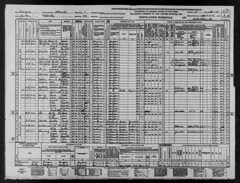
Showing posts with label 1940 census. Show all posts

03 August 2012

A Complete 1940 Census?

     I woke up today to an email from Ancestry.com, telling me that they had finished indexing the 1940 Census. Yay! North and South Carolina are online and I can now complete my ancestor search.  I was still looking for:

  • Nina Albea - Greenwood County, SC - born 1878, SC
  • Vary "Mack" Huyler - Guildford County, NC (maybe) - born 1903, SC
  • John and Ida Huyler/Hyler - Lexington or Richland Coounty, SC - born 1861 and 1863, SC

     But after hours of searching, I'm still in the same position I was in this morning: census-less. I've seen a lot of silly errors in Ancestry.com's 1940 Census records and I'm hoping that that's my problem. Hopefully when FamilySearch releases these states I'll be able to find my ancestors. 


13 July 2012

More 1940 Census Records on Ancestry.com - Including Georgia!

     I just got an email from Ancestry.com that 15 more states had been added to their 1940 Census collection. Included in these states is one I'm really excited about: Georgia. (Also added: Alabama, Arizona, California, Hawaii, Indiana, Kansas, Kentucky, Michigan, Montana, Nebraska, New Hampshire, Oregon, Washington or Wisconsin)

     For the most part, I have already found most of my Georgia ancestors in the 1940 Census - but those are my Dad's relatives. They were farmers who sat in the same place for a few hundred years and made things easy. My mom's ancestors on the other hand... talk about mobile.  It's not like they were moving all over the country; they just moved down this street and up this other one and maybe across town or to the neighboring state for just a few months. And they did this constantly.

     I had multiple addresses cir 1940 in which to look for my Great-Great Grandparents, Leverett and Louise Waters. They were nowhere to be found. I did find their daughter (my great-grandmother), one of the their daughters-in-law (sans husband) and Leverett's sister-in-law (sans husband).

     With today's addition of Georgia into Ancestry's 1940 Census collection, I was able to find Leverett and Louise. I learned that Leverett apparently never had any official schooling (which I had guessed based on his shakily printed signature) and Louise had only four years. At the time Leverett was working as a barber and Louise stayed at home. Their youngest boy, Jack, was still at home.

     Now let's just South Carolina indexed and I'll be happy!


08 June 2012

My 1940 Census Indexing Progress

     The 1940 Census is 57.84% finished, thanks to volunteers using the Family Search Indexing software. There are 18 searchable states and a number of other states at 100% that are going through the final steps. Wouldn't you know, pretty much all of these are states are ones that I'm not interested in. Sigh....

     So that means that I'm still going at it. Georgia is at 36% and currently working its way through Atlanta. South Carolina is running a little further behind at 23%.  Although I don't index every day, I do try to do some a few days a week.

     It's fun to see what I've accomplished: 2,840 names indexed and 4,480 names arbitrated. Arbitrating can be a lot faster, though sometimes it can be more difficult. I tend to do a few batches of arbitration and then do an indexing batch.

     Yesterday, I got an email from FamilySearch Indexing, letting me know that there were new achievement badges available.  I have indexed and arbitrated 1940 Census records from 15 states! I know that there are some folks out there who made a point to index a batch from every state, which is pretty impressive. I'm happy to see my Delaware badge, which shows that I was in it from the start. Here are all of my badges:


27 April 2012

To Lead or To Be Led

    So far I have indexed over 1500 names for the 1940 Census. Those names are from a number of states, but many of them from Georgia. Aside from working on batches from Georgia, I have worked on the states given highest priority. It seems that a state is finished in about three days (or even less) once it's given "priority" status.  I'm hoping that any day now Georgia will be the highest priority state. Right now the priority is Louisiana.

     It seems to me that it's important to put at least half of my indexing effort toward the prioritized state, even if that state is of no interest to me. By concentrating on a specific state, volunteers can complete a state's index sooner. On the other hand, if everyone indexes only at random, it will take a lot more time to create even a single state index.

     What do you think? Focus on your own interest or work on the designated "priority" state?


21 April 2012

Doing My Part to Make the Census Searchable


     At this point, any ancestors I haven't found yet in the 1940 Census will not be found until an index is available.  The best way to gain access to an index will be to help create one.  The 1940 Census Community Project is working to create an index with the help of volunteers like me. So far, I've indexed a little more than 1,000 names from the 1940 Census using the FamilySearch Indexing program.  The index we're creating will be available on FamilySearch.org, Archives.com, FindMyPast.com and the National Archives.

     The Census Community Project uses FamilySearch Indexing's program. I've been indexing with this program for a few years now, but every project is different. So what have I learned while working on 1940 Census images?

  • I'm human and I make mistakes. But that's ok. As with all other FamilySearch Indexing projects, each record to transcribed by two people and then checked over by an arbitrator. My current rate of accuracy is 98%. Pretty good I think.
  • You can review your results in detail (log into the indexing software, click the "Arbitration Results" tab and then the "review batches' button). Some of the errors I make are "oops!" and one or two are "I was right on that..." You can ask for changes marked against you to be re-reviewed. Even arbitrators can make mistakes. 
  • If you read the instructions, you'll avoid common mistakes. Each field (house number, surname, place of birth, etc) has specific instructions to address common questions. Read them and learn things like:
    • If the line is blank, mark it blank and do not index the line number.
    • Children under five should have their "1935 locations" marked blank, even if the enumerator recorded a location.
    • If someone was living in the "same place" or "same house" in 1935 then you do not record a county or state, even if the enumerator recorded them.
  • I prefer to index down columns instead of across rows. It's faster. Some of the fields will pre-fill, such as surname, if I navigate down a column using the down arrow key.  This method also enables me to concentrate more on a specific field instead of having to jump around. It disconnects me from the individual person and helps me focus on reading what's on the page. Usually this is a good thing. Sometimes it hurts though, if the enumerator makes a mistake (ex 1935 locations for someone under 5).
  • The states of interest to me are not going to be complete for a while. The western half of the US is being indexed much more quickly than the middle or east. 
  • I can track the progress of the indexing here.
     I don't know if the above list is encouraging or discouraging or neither, but indexing really is a great experience.  I feel like I've accomplished something and helped someone. I encourage anyone interested in genealogy to take part in this project. Again, you can find out how to participate here.

     Please note that this blog was inspired by, and written in response to, a contest hosted by The 1940 Census Community Project and does constitute a contest entry for a prize.

06 April 2012

Save Yourself Some Time and Grief: Ask For Help

     I have found all of my dad's direct ancestors in the 1940 Census, as well as a few collateral folks too. On the other hand, I have found only my mom's mom and maternal grandmother. I had no success finding any of her father's family or the rest of her mother's family. The problem comes from them being mill workers and moving often. It's difficult to find the correct address, especially when they were living in smaller towns without online city directories. I'd browsed through about eight EDs looking for my mom's dad and his family to no avail.

     I'd meant to call my Great-Aunt Ree earlier in the week for help, but got side tracked with searching for my dad's people.  Today I asked my mom to call Aunt Ree, to which she responded that I should call her. She's making me work on my social skills... sigh. So I called her and very quickly realized why I couldn't find her or her brother, my Grandaddy: I was looking in the wrong city. I thought that she's said before that the family was in Greenville, SC in 1940, but today she said that they had been living on Greene Street in Greenwood, SC.

     I chatted on the phone with her while I browsed the two EDs that contained Greene Street. I learned that they moved to Greenville in '42 and that her father, who died in '47, had never owned a car. Oddly though, he had driven a taxi cab for a few years. After the family moved to Greenville, they often visited family still in Greenwood by riding the P&N Train back and forth.  Her parents had worked in mills in Greenwood and for other mills in Greenville that were all owned by the same company. She can remember so many little details about her childhood and was more than happy to tell me everything she could.

     Unfortunately I did not find her on Greene Street, so questioned her some more. Before that they had lived on Pelzner. And that's where I found them: 515 Pelzner Street.


    I'm really glad that I called my great-aunt, otherwise I probably would not have found this family until an index became available. And it looks like South Carolina is going to be late on the list.  So do yourself a favor: if you're having trouble finding your family and there's someone you can ask for help, do so.

05 April 2012

George Washington in the 1940 Census


I found George Washington in the 1940 Census.  Can you see him?


I Found Them In 1940 And I Still Don't Know the Answer

     One reason I was looking forward to the 1940 Census was because I was curious about the organization of my Granny's household at the time. I knew that her parents had separated and wanted to know if they had divorced.  Their death certificates give conflicting information: one stating they were married, the other divorced.

     On Apr 2nd I found my granny, Sarah Britt, her father, Nathan, and brother, Evoid. They were living in Elbert County, Georgia and listed only two pages away from the man Sarah would marry that August (yes, she was 14). There was no sign of Sarah's mom, LeDora, nor her two sisters, Ollie and Helen.  And what is Nathan's marriage status. Married? Divorced? Oddly, it looks like AS. What on earth...?  (Also, I will not blame the indexer who will not be able to figure out Evoid's name)


     Maybe if I could find LeDora it would help clear things up? It took me two more days to find her, having browsed through 10 (!!!) enumeration districts to do so. But I did find her, living with her oldest daughter and her husband, as well as her youngest daughter. Maybe her marriage status will provide an answer? Nope; its a scribbled mess. (Also, I'm a little concerned that Ollie was 15 and married to a 35 year old)


     With the help of some folks on Twitter, during the Ancestry.com chat with Crista this afternoon, I think we've figured out Nathan's marriage status. They started to write 'M' for married but stopped after only writing the front flick. They crossed out the flick and then wrote an 'S'.

     For LeDora, it looks like they wrote 'M' and then scribbled it out. They then wrote something else - a '7'? That doesn't make sense. EDITED UPDATE: While watching DEARMyrtle's webinar tonight I learned that it is in fact a crossed out M with a 7. It turns out that the 'M' was recorded in the field and an office worker crossed it out and wrote 7 because there was no spouse listed. Voila!

     But I guess it does imply a few things. They were not divorced at the time, otherwise they would have just said so. However, they probably did not consider themselves married either. And I'm kinda sad that the kids got split up like that. But those are the facts of life I suppose.

04 April 2012

A 1940 Census Search Status Update

Whitfield / Huyler - 1940 Census     The census release got off to a rocky start on Monday, but by Tuesday everything was running smoothly. The National Archive's website was running perfectly for me while Ancestry.com and FamilySearch were steadily adding images. Today, MyHeritage became the first commercial site to have all images online.

     So, how am I doing? Here's a list of my direct line ancestors. I had EDs picked out for all of them and have conducted searches for them.

FoundRelationship    MissingRelationship
Betty HuylerGrandmother    Roy AlbeaGrandfather
Ruby Huyler WhitfieldGreat-Grandmother    Vernon & Auline AlbeaGreat-Grandparents
Sarah BrittGrandmother    Vary "Mack" HuylerGreat-Grandfather
Nathan BrittGreat-Grandfather    Nina Albea2xG Grandmother
Thomas CraftGrandfather    John & Ida Huyler2xG Grandparents
BE & Ruth CraftGreat-Grandparents    Ledora Barfield BrittGreat-Grandmother
Stephen T Boatright3xG Grandfather    Frances Boatright Barfield2xG Grandmother
William D Witt2xG Grandfather    Effie Craft2xG Grandmother
    Leila Evans2xG Grandmother
    Leverett & Louise Waters2xG Grandmother

    When I look at this list, something stands out: for the most part the left hand side are farmers and the right hand side are mill workers or widows. Mill workers moved a lot. A lot. Looking at city directories, they are almost never in the same place two years in a row. And the widows have possibly moved in with one of their children, leaving the homes they had with their husband.

     I'm going to keep looking for my missing ancestors, but I'm not sure if I'm going to be able to find them without an index.  As far as index completion is concerned, I think I've heard that one might be completed as soon as 6 months.  I'm going to have to do my part and do some more indexing with FamilySearch. I've done two pages so far and have found it exceedingly easy. Hopefully they'll start Georgia and South Carolina soon!

02 April 2012

What I Found So Far in 1940


     It's been 12 hours since the official release of the 1940 Census and I've managed to download 2 EDs. I've spent many other hours searching for the rest to no avail. And it's not because I don't know where they are or I can't find them, it's because the census is too popular for its own good.

     The National Archives created a lot of hype regarding the census release and, as the Ancestry Insider predicted, it crashed their website.  From the minute the National Archive's website opened it was overloaded and difficult to use. The presentation during the opening ceremony didn't even work! About 45 minutes in the site went down completely.  When it came back up it wasn't much better. Images do not load. Your best bet is to download the images. That is, if the download process will work.

     Understandably a number of folks expressed their displeasure and frustration on social media sites such as Facebook and Twitter - and I was one of them. As my mom can attest, I have zero patience. If someone tells me I can do something at a certain time, I expect to be able to do it. I completely understand that traffic to the site was insane, but that doesn't change my frustration level. Just being honest.

     When I got frustrated with the Archives site, I switched to Ancestry.com. They had managed to add a few Pennsylvania Counties, home to my brother-in-law's family. I found his grandfather and his parents, which I sent to my sister. I wasn't really too surprised that my brother-in-law was 'blah' about the find.

     Back the Archive's site: they did make an effort to improve access from minute one. I honestly think they thought they were prepared. And I was going to say that their efforts have helped only a little, but just now I re-ran a search to great success. I'm currently downloading ED 73-1 and ED 52-24. Things are looking up!

Today Is The Day

From Ancestry.com's main page:

     At 8:30 am I'll be tuned into the National Archive's live webcast. I'll then start searching for my family on their site. But I'm also curious about how quickly other sites, such as FamilySearch and Ancestry.com will have images online. From the graphic above, it looks like Ancestry.com plans to have the first images up some time today. 

     I have been invited to be part of the Ancestry.com 1940 Aces program. They promise to provide updates to the progress they make in getting the census images and indexes online.  I like that they're not making promises on their progress but are being realistic. They're going to do their best and they'll keep us updated.

     I'm looking forward to exploring the 1940 Census... but maybe for now I should get some sleep. Only 8.5 hours to go!

Update: 8am
     Ancestry.com has select images available for American Samoa, Delaware, DC, Guam, Indiana, Maine, Nevada, Panama Canal, Rhode Island and the Virgin Islands.
     FamilySearch has the complete images available for Delaware.

31 March 2012

He Was Married Four Times to Two Women

     I'm doing a little bit of last minute 1940 Census prep research.  I have never been able to find my maternal grandmother's parents, Vary "Mack" Huyler and Ruby Waters, in the 1930 census.  They would be married less than a year later in Atlanta, Georgia, but I just can't find them.

     Thanks to city directories, I know exactly where Ruby will be found in 1940: living in Atlanta with her second husband.  But what about Mack? I know he left Ruby shortly after their daughter was born to "find work." He didn't return for 14 years. So where was he in 1940?

     I know from his social security application that he was in Augusta, Georgia in 1937. That's where I planned to look. But today I decided to do one last run through city directories to see if I could find a listing for him in a 1940 book. I didn't find him in 1940, but I did find him in 1939 - in Greensboro, North Carolina. With a wife. Surprise!

     Well, something of a surprise.  I know who Ruth was. She was Ruth Sexton, Mack's second wife... or third... or would that be fourth? I guess it depends on how you count. Based on the information I have, it now looks like she's both Mack's 2nd and 4th wife, with my Great-Grandmother Ruby Waters being his 1st and 3rd.  Mack was married four times, to two women.  Here's the timeline I can piece together:
mack & ruth huyler
  • Feb 1931 - Mack Huyler m. Ruby Waters, Atlanta (marriage certificate)
  • abt 1937 - Ruby Waters m. Cecil Whitfield (city directory)
  • by 1939 - Mack Huyler m. Ruth Sexton (city directory)
  • Dec 1947 - Mack Huyler m. Ruby Waters (bible record)
  • abt 1960 - Mack Huyler m. Ruth Sexton (obituary)
     I have evidence of a lot of marriages, but I don't have any official records. Even the first marriage between Ruby and Mack, I have a certificate but I haven't found an actual license (I assume the online database is incomplete and that microfilm in not available at the archive).  And what about divorces? Hopefully the couples were legally divorced...

     And hopefully Mack can still be found at 710 Railroad St for the 1940 census.  If so, he'll be in ED 41-58 in either block 313 or 314. Fingers crossed!

29 March 2012

What's So Exciting About the 1940 Census?

1940 census     I think my co-workers think I'm a little crazy. Ask me what's new or what I've been up to lately and I'll start gushing excitedly about the upcoming release of the 1940 census.  I mostly get a blank look before they remember that I do genealogy as a hobby (I probably offered to look their ancestors up at some point). I've has some funny responses, including "oh, you mean that thing they did a few years ago - I didn't fill that out."

     I have Monday and Tuesday off from work (random chance) and my mom is working evening shifts. I've already told her that I'll be putting her to work (to which she responded with a "oh really, you think so do you?" look). If our internet isn't going fast enough (it's basic DSL) I might go sit in the coffee shop at B&N to see if theirs is any faster (also, I wouldn't mind a brownie).  I'm prepared for site delays or crashes, but I'm also hoping for the best.  Typing this I feel like I'm getting even more excited for Monday.

     But why am I so excited? I'm pretty much geeking out about the 1940 Census and my co-workers don't really get it. Heck, I've read blog posts by genealogists who say that they're not that excited. So let me explain "why."

  • I ♡ genealogy.
  • One of the reasons I love genealogy is because it's like a puzzle. Finding my family in the 1940 census will be like one big giant puzzle (where's Waldo...?). I have a good number of ancestors who were alive in 1940 that I want to find.
  • The census will provide new information or clarify information I already have: jobs, relationships, locations, etc. Even if I already know where they lived from city directories, I'm still going to gain information from the new records.
  • I ♡ old documents. Even if I don't get any new information (but I will!), I will still have a new record of each ancestor. A new document that lists their name = exciting.
  • The attention that the census release will bring to genealogy is great. More people doing family history research can only be a good thing. More money for companies, more volunteers = more records available online. Yay!

15 March 2012

Tech Talk

     It's interesting to think about the changes that have come about in technology since, and during, my grandparents' generation.  In the 1940s, just like today, technology was constantly evolving and, in most cases, have no resemblance to today.

     As a young teen girl in Atlanta, my Grandmama road the streetcars to get around town.  These have been defunct since 1949 but are being re-installed this year.  I kinda want to go ride one when they get them up and running to see what it might have been like for her. (See a photo of a 1945 streetcar)

     My Great-Aunt Ree recently mentioned that the family often spent the evening together, sitting around the radio. Her family wouldn't have a television until the late 1940s when her step-father bought one. She also remembered living in a hotel owned by her family and the telephone in the lobby. One phone for the entire hotel, verses today where everyone has a phone in their pocket!

     My father's sister, my Aunt June, remembers growing up in a house where the only source of water was a well.  The family had to tote water into the house for washing clothes, dishes and themselves. And yes, they had an outhouse.  They wouldn't have inside running water until well into the 1950s!

     I can't even imagine how changes in medicine and health care have changed lives. My Great-Grandfather died of tuberculosis in 1947. New cures and standard vaccinations for many diseases, such as whooping cough and diphtheria, became common in the late 1940s and saved countless lives.

     I'm very grateful for the improvements in technology, as I'm sure generations past have been. To find out more about life in the 1940s, check out the 1940 Census website. If you're a blogger, make sure to sign up for their Ambassador Program. You'll also find out more information on how you can take part in indexing the 1940 Census. You can also enter contests to win prizes (simply by writing blog posts like this one, which is an entry into a contest to win a $50 gift card).

08 March 2012

Talking with Aunt Ree about the 1940s


     I visited with my Great-Aunt Ree yesterday and made a point to talk to her about our family history. I've interviewed her before and she's always willing to talk about anything she can remember.

     I asked her about growing up in mill towns.  Most of her memories come from when she was between 10 and 15 years of age, around 1940 to 1945.  This is great information considering my interest in the upcoming 1940 Census release.

     Her family worked in cotton mills in Greenville, South Carolina, such as Brandon Mill and Judson Mill, before moving to Atlanta around 1945.  Her mother, Auline, worked as a spinner and her father, Vernon, worked as a doffer, while Aunt Ree worked as a battery hand. My Grandaddy, Ree's brother, also worked in the mills though I'm not sure what job he did.

     Apparently Vernon was involved in a (failed) effort to start a Union during the depression, which got him blacklisted from mill work. The family had to move to Clinton, SC to find work for a while until they could find work in Greenville again.  Aunt Ree said that a mill worker might make $20 a week, spent $2 to rent a house in the mill village, and spent $5-$7 on groceries. During the war families never ran through their ration coupons (except sugar) simply because they didn't have the money to do so.

     I recorded our conversation and will create videos about them. If you haven't seem them yet, you can view some of the videos I've made from previous conversation with Aunt Ree, many of which pertain to World War II. Click Here.

25 February 2012

How I'm Looking for Grandmama in the 1940 Census

Betty Huyler
     The first person I want to find in the 1940 Census is my maternal Grandmother, Betty Huyler. I'm interested in finding her first for a number of reasons: this is her first census (she was born in 1931); I can't find her parents in 1930; she'll be living with her step-father, who I want to learn more about; I know her exact address in 1940; I really want to know where she was in 1935.

   Betty had an interesting childhood. Her parents were separated due to the Depression and a "search for work" that lasted 14 years. Her mother temporarily remarried and Betty's last name was Whitfield for a few years. She spent some time in an Orphanage and some time being raised by her Grandparents, Leverett and Louise Waters. As a girl she rode the street cars in Atlanta and was almost killed when she was hit by a car.  That accident caused her to lose many of her childhood memories and she was unable to provide details on many of the interesting aspects of her childhood.

     The key to finding Betty in 1940 is that I have her exact address from a 1940 city directory - or rather, her mother and step-father's address: 413 Central Ave SW, Atlanta, Georgia.  So this should be easy, right? Not necessarily. Atlanta is known for changing street names, both historically and still today. Often streets actually had multiple names at the same time, until they were standardized (see this map from 1895 of double-named streets).  Lucky for me, it appears that Central Avenue SW has maintained it's name since it was changed in 1901 from Lloyd Street.

     Knowing Betty's address is important, since there will not be a name index when the census images are released on April 2nd. Armed with an address, I headed to Steve Morse's One-Step website (please note that I had a hard to utilizing this website using Safari and had to switch to Firefox).

     I used the ED Finder Utility to find the enumeration district that Betty should be in (this tool is available for cities of 50,000 or more people). I did a search for Georgia > Atlanta > Central Av and came up with eight EDs, which is still a lot.  I checked the address on Google Maps to find cross streets: Alice, Pryor and Pulliam.  This brought my results down to two EDs: 160-14 and 160-17.

     Clicking the button for these EDs, I was then able to view details on the microfilm that this district appears on.  It looks like this area, 160-14, was part of Atlanta's 1st Ward and is part of Tract F-45.
     Click! This is a microfilmed image of the Description of ED 160-14 in Atlanta. I can see the names of the streets for each district - this is the original information from which the table above was extracted.


     But I still have two EDs to check. Is it going to be 160-14 or 160-17? They are both in Tract F-45.

     I next, used the National Archive's Online Public Access search to find a the 1940 Census Enumeration Map of this area. I searched for "1940 Census Enumeration Map Atlanta Georgia" and came up with the map of Tract F-45. You can see Central Avenue just to the left of the break in the middle of the image. You can also see Alice, Pryor and Pulliman - the cross streets I pulled from a modern Google map and used to identify this ED. Very faintly, you can see a 14 and a 17 written in the image as well. Those are the specific areas that I will be browsing through on the census to find my Grandmama. Based on this map, I think I will find her in 160-14.  I can't wait for April 2nd!


21 February 2012

Ready for the 1940 Census

     I'm very much anticipating the release of the 1940 census. I'm planning to be prepared and have made a list of locations to search just as soon as the records are available. I used the tools at http://stevemorse.org/census to convert the 1930 locations of my ancestors into possible 1940 locations. For the most part my ancestors were farmers who stayed in one place, which will make them easier to find. I do have a few ancestors who I can't find in 1930 or who I know or suspect had moved. They'll prove more a challenge!


Name // 1930 Location // Possible 1940 Location 
Grandparents
• Thomas Craft & Sarah Britt Craft // Dist 20, Gaines, Elbert, Georgia // R669 - Dist 52-20, MilD 199 Gaines, Elbert, GA
• Roy Albea // Dist 13, Greenwood, Greenwood, South Carolina // R3815 - Dist 24-15, Greenwood Twp, Greenwood Ward 5, SC
• Betty Huyler (possibly called Whitfield) // n/a // Atlanta?? 
Great-Grandparents: 
• BE & Ruth Craft // Dist 20, Gaines, Elbert, Georgia // R669 - Dist 52-20, MilD 199 Gaines, Elbert, GA
• Ledora Britt // Dist 24, MilD1560, Emanuel, Georgia // R669 - Dist 52-24, MilD 1560, Outside Twin City, Graymont, Emanuel, GA (or poss ED 52-23)
• Nathan Britt // Dist 24, MilD1560, Emanuel, Georgia // Elbert County, GA ??? Dist 52-?
• Vernon & Auline Albea --- see Roy Albea
• Ruby Waters Whitfield ---- see Betty Huyler
• Vary "Mack" Huyler // Augusta, GA? --- 1937 location // R704 - Dist 121-4, Augusta Ward 1, Richmond, GA -OR- R704 - Dist 121-7, Augusta Ward 2, Richmond, GA 
Great-Great Grandparents: 
• Geo Rob't & Effie Craft // ED 56, Birmingham, Jefferson, Alabama // R95 - Dist 68-163, Prect 34 (tract 3), Birmingham, Jefferson Co, AL
• Leila Evans Brown // Dist 20, Gaines, Elbert, Georgia // R669 - Dist 52-20, MilD 199 Gaines, Elbert, GA
• S Frances Barfield // ED 8, MilD 57, Emanuel, Georgia // R355 - Dist 54-8, MilD 57, Emanuel Co, GA
• Nina Albea // ED 13, Greenwood, Greenwood, South Carolina // R3815 - Dist 24-15, Greenwood Twp, Greenwood Ward 5, SC
• Wm D Witt // ED 11, Greenwood, Greenwood, South Carolina // R3815 - Dist 24-13, Greenwood Twp, Greenwood Ward 3, SC
• John & Ida Hyler // ED 29, Lexington, Lexington, South Carolina // R3823 - Dist 32-30, Lexington TWP, Lexington, SC
• Leverett & Louise Waters // ED 35, Atlanta, Fulton, Georgia // R725 - Dist 160-2, Atlanta, Ward 1, Fulton, GA -OR- R725 - Dist 160-3, Atlanta, Ward 1, Fulton, GA
     I also signed up for the 1940 Blog Ambassador Program, part of the 1940 Census Community Project from Family Search.

09 January 2012

The 1940 Census: A Webinar from the Friends of the National Archive Southeast Region

Image used during the webinar
     I just finished watching a webinar about the 1940 Census by the Friends of the National Archives Southeast Region and Constance Potter of the National Archives. This is was a great webinar that covered a lot of information. Here's a breakdown of some of what I came away with, much of which I tweeted during the webinar:
  • There will be a new website/landing page for the 1940 census on the NARA website. I'm not sure, but I got the feeling it could be live very soon. There will be a notification when the website is up.
  • On top of videos available on YouTube about the 1940 census, NARA will be releasing radio public service announcements called "Uncle Sam Calling." You can already find transcriptions of these at Steve Morse's site [here]. (Not sure if these will be on YouTube or the new 1940 website)
  • The 1940 census does not (yet!) have a person index, but is indexed by State, County, Civil District and Enumerated District.
  • Aside from the questions that were asked of the population, a number of questions were proposed but not asked. Ex: Do you dye your hair and if so, what color; who was over 6 feet tall; do you own a waffle iron and a bible.
  • Those in a jail and penitentiary were not recorded as "inmates," but were recorded by their prison number. This could be very helpful!
  • The census requires that the person providing the information for each family be marked with an X. Unfortunately, from what archivists have seen, it seems like this was rarely done. 
  • The census asks where each person lived five years ago on 1 Apr 1935. They even note if it's the "same house."
  • Military veterans are listed with the war they fought in. 
  • If a person is receiving social security benefits this is listed, though social security numbers were not recorded.
  • Women were asked about the number of marriages they'd had, when they were married and how many children they had. Stillbirths were not supposed to be counted - but like many other questions this rule wasn't always followed.
  • A census of housing and a census of agriculture were taken, but have since been destroyed. Only statistical data remains.
  • The Enumeration District Descriptions are available on OPA (Online Public Access: http://www.archives.gov/research/search) and give details about each district, including schools and other institutions included within, as well as streets.  You can see the best way to search for these here: http://www.archives.gov/research/census/1940/start-research.html
  • NARA recommends using the 1940 Census tools by Steve Morse to help plan your research ( http://stevemorse.org/census)
     The webinar was apparently extremely popular - more than expected it seems.  A lot of attendees had trouble with sound or even getting into the webinar.  There will be an archived copy available, but only to members of the Friends of the National Archives Southeast Region. This is a $25 a year fee and you can find more information here: http://friendsnas.org/membership.htm.

     Can you believe we're only 83 days away from 1940 census access?

02 April 2011

A Year From Now I Hope To Find

     A year from today the 1940 Census will officially be released. According to the National Archive, "The digital images will be accessible at NARA facilities nationwide through [their] public access computers as well as on personal computers via the internet."  I know that April 2, 2012 will be a busy day for Genealogist, excited to start looking for their ancestors [note to self: take a vacation day]. And, as The Armchair Genealogist recommended, it's best to be prepared.

     Here's my list of searches that I'll be doing first, once the 1940 census is available. I'm most interested in looking for individuals who would have dealt with life changes during this time, or those that I couldn't find in the 1930 census.


  • Grandmother, Betty Huyler. Betty was born in 1931, so this will be the first census she appears in. And I have no idea where I'll find her. Is she with her mother and step-father, or will this be one of the times when she was left with her grandparents? Or perhaps 1940 is when she was living in the children's home? Oddly, I'm hoping for the last, because I'd really like to find out more information about the children's home, which Betty didn't even know the name of.
    • Great-Grandfather, Mack Huyler. I couldn't find Mack or his soon to be wife, Ruby Waters, in the 1930 census, which was taken a year before their marriage. Mack left home in 1932 and claimed to have spend 15 years as a hobo. He could be anywhere! Though I do know that he requested a SSN in 1937 while living in Augusta, GA.
      • Grandmother, Sarah Britt. Sarah grew up in Emanuel County, Georgia, but at some point moved with her father and other relatives to Elbert County, Georgia. Which location will she be at in 1940?
      • Great-Grandparents, Nathan and Ledora (Barfield) Britt. This couple "separated," with Nathan remarrying later. I hope that the 1940 census might give me some insight into the timeline of their marriage. If they are living apart at this time, will they be listed as married or divorced? Where will their children be?
      • Grandfather, Thomas Craft. In 1939 Thomas left his CCC post in North Carolina and returned home to Elbert County. Probably. Will he be living with his parents? Or perhaps his uncle, Paul Craft? I know that Paul was a witness at Thomas's wedding and that Thomas worked as a sharecropper on his uncle's farm, ultimately purchasing the property. I'm very interested in the location of Paul's farm in the 1940 census. 
      • The children of Milton Waters. Milton was the brother of my Great-Great Grandfather, Leverett. I've had trouble researching this family beyond this generation, as well as trouble with Milton who died at an unknown date, possibly between 1920 and 1930. I think I've found his children in 1930, but can't confirm it. I'm hoping to have better luck locating Ben, Ida and Marie Waters in the 1940 census and, through them, find more information on Milton. 
           Some aspects of the 1940 census will provide more insight into the lives of our ancestors than ever before.
      • Who Told? This census will tell us who provided the information for each family. This will help determine how accurate the information is.
      • Education Level. This census moves beyond indicating if each person can read or write. This year requests the highest grade level completed.
      • Employment. Due to the Great Depression, there are a lot of questions about employment, from simple to detailed.
      • 14 & 40. A number of questions from previous years are missing from the general questions (ex. birthplace of parents), but two individuals on each page will be asked more detailed questions about their parents, language, marriage and veteran status.

      28 October 2009

      The Census - then and now

      I know most genealogists are probably looking forward to the upcoming 2010 Census - I know I am. I've never actively taken part in a census before, but I plan to this year (my dad just filled it out and sent it back without any fan-fair). And, of course, genealogists are interested in past censuses.

      As a subscriber to the US National Archive's YouTube account, I saw that they had put up video from the 1940 census. It contains very cool archival footage and has that patriotic feeling from similar government productions of the same time period. Here's one of the videos:


      Also on YouTube, the Census Bureau has its own channel. It looks like they want to educate folks about how the census will be taken and what the different steps there are in the process. Check out their latest of their video:


      LinkWithin

      Related Posts with Thumbnails